



Pyrometer : 파이로미터
파이로미터는 물체에 접촉하지 않고 온도를 측정하는 장비입니다. 이는 비접촉 온도 측정이 필요한 많은 산업 분야에서 유용합니다. 파이로미터는 금속 가공, 유리 생산, 반도체 제조 및 기계 시스템 모니터링 등에서 일반적으로 사용됩니다.
파이로미터는 물체가 방출하는 적외선 복사를 검출함으로써 동작합니다. 절대 영도보다 높은 온도를 가진 모든 물체는 인간의 눈에 보이지 않지만 적외선 센서로 검출할 수 있는 적외선 복사를 방출합니다.
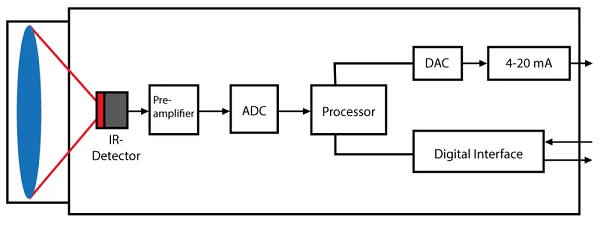
파이로미터는 일반적으로 광학 시스템, 검출기 및 전자부의 세 가지 주요 구성 요소를 갖습니다. 물체의 표면 온도를 측정할 때 광학 시스템은 물체가 방출하는 에너지를 포착하여 적외선 대역에 민감한 검출기에 집중시킵니다. 검출기의 전기 신호는 물체의 온도, 주변 온도 및 검출기의 감도에 따라 달라집니다. 이 약한 전기 신호는 파이로미터의 전자부에 의해 증폭되고 디지털화됩니다. 디지털화된 데이터는 보정 데이터를 사용해 지속적으로 보정되며, 그런 다음 온도 값이 도출되고 인터페이스에 따라 아날로그 또는 디지털 출력으로 추가 신호 처리가 이루어집니다.
비접촉온도계(파이로미터)는 서로 다른 스펙트럼 범위, 측정 범위, 속도, 감도 및 해상도를 가진 다양한 모델로 제공되어 다양한 예산 수준에 맞출 수 있습니다. 또한 다양한 용도에 맞춘 서로 다른 성능 등급 정렬 옵션을 제공합니다.
비접촉 온도계(파이로미터)의 가장
큰 장점은 직접 접촉이 현실적이거나 안전하지 않은 환경에서 원거리에서 온도를 측정할 수 있다는 점입니다. 이들은
빠르고 정확한 판독값을 제공하며 이동하는 물체나 표면을 방해 없이 모니터링할 수 있습니다. 그러나 방출율(방사율) 변화, 반사 및
환경 조건과 같은 요인들이 정확도에 영향을 미칠 수 있습니다. 신뢰할 수 있는 측정을 위해서는 적절한
보정과 재료 특성에 대한 이해가 필요합니다.
A pyrometer is an instrument used to measure the temperature of an object without touching it. This is valuable in many industries where non-contact temperature measurement is necessary. Pyrometers are commonly used in metallurgy, glass production, semiconductor manufacturing, and mechanical systems monitoring.
Pyrometers work by detecting the infrared radiation emitted by an object. All objects with a temperature above absolute zero emit infrared radiation, which is a type of electromagnetic radiation that is invisible to the human eye but can be detected by infrared sensors.
Pyrometers typically have three main components: an optical system, a detector, and electronics. When measuring the surface temperature of an object, the optical system captures the energy emitted by the object and focuses it on the detector, which is highly sensitive to the infrared bandwidth. The detector’s electrical signal depends on the temperature of the object, its ambient temperature, and its sensitivity. This weak electrical signal is then amplified and digitized by the pyrometer’s electronics. The digitized data is continuously corrected using calibration data, and then the temperature values are obtained, followed by further signal processing for analog or digital outputs, depending on the interfaces.
Pyrometers come in different models with varying spectral ranges, measurement ranges, speeds, sensitivities, and resolutions, catering to different budget levels. They also offer different performance class alignment options for various applications.
The most significant advantage of pyrometers is their ability to measure temperature from a distance, which is essential in environments where direct contact is not practical or safe. They provide fast and accurate readings and can monitor moving objects or surfaces without interference. However, their accuracy can be affected by factors such as emissivity variations, reflections, and environmental conditions. Proper calibration and understanding of material properties are necessary for reliable measurements.