



Optics : 광학계
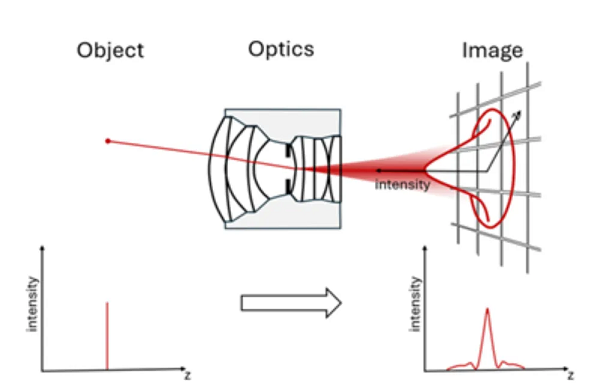
광학(Optics)은 빛의 생성, 전달, 상호작용 및 검출에 대한 연구를 포함합니다. 이러한 원리가 공학적 과정에 적용될 때, 해당 분야는 일반적으로 광자학(Photronics)이라고 불립니다. 렌즈와 거울 같은 광학 요소는 복사를 검출기로 유도하고 집중시키는 데 필수적입니다. 이 과정은 온도 측정을 포함한 다양한 응용 분야에서 사용되는 영상 시스템에 있어 핵심적입니다.
빛의 경로를 제어하기 위해 광학 요소는 복사의 형태를 만들고 주로 검출기에 집중시키는 데 사용됩니다. 영상화 과정은 종종 렌즈 또는 거울 시스템으로 수행됩니다. 온도 측정을 위해 거울은 보통 반사성 금속 코팅을 가지고 있습니다. 이 코팅은 장치의 파장대에 대해 크게 의존적이지 않으므로 지배적인 색수차를 유발하지 않습니다. 반사 부품이 통합된 기기들은 주로 복잡한 비축 설계나 이차 거울에 의한 빛의 차폐로 인해 이미지 콘트라스트가 감소하는 문제를 겪습니다.
반사 요소 대신 렌즈를 사용하여 복사를 형성할 수도 있습니다. 빔은 광학 요소를 통과하고 굴절에 의해 영상면에 초점이 맞춰집니다. 빛이 렌즈의 각 표면을 통과할 때 원치 않는 반사가 발생하여 전송 손실을 일으킵니다. 렌즈 재료 자체는 빛을 흡수하고 산란시켜, 적용된 모든 파장대에 걸쳐 일반적으로 색수차를 야기합니다. 색 편차를 줄이기 위해서는 서로 다른 분산 특성을 가진 재료를 조합하는 등 가장 적합한 재료를 선택해야 합니다. 렌즈가 많아질수록 수차를 줄이기 위한 자유도가 증가합니다. 과거에는 적외선 광학 개발에 구면(surface)을 사용했지만, 오늘날에는 광학의 크기와 무게를 줄이고 회절한계(diffraction-limited) 광학의 발전을 촉진하기 위해 열화상에서 비구면(aspherical) 렌즈 형상을 통합하는 것이 일반적입니다. 중파 적외선(MWIR) 대역에서는 실리콘이 일반적으로 사용되는 결정체인 반면, 장파 적외선(LWIR) 응용에서는 게르마늄이 선호됩니다.기술의 발전으로 적외선 칼코게나이드(Chalcogenide) 유리가 열화상 응용 분야에서 점점 인기를 얻고 있습니다.
광학계는 렌즈 또는 반사 요소와 복사의 전파를 제어하기 위한 조리개로 구성됩니다. 광학 시스템의 가장 중요한 매개변수는 초점거리, F-수(F-number), 그리고 사용되는 파장대입니다. 초점거리는 카메라의 시야(FOV)와 관련이 있고, F-수는 높은 광학 해상도와 따라서 높은 D:S 비율을 위해 중요합니다. F-수(N)는 카메라의 NETD와도 관련이 있습니다. NETD는 F-수 N=1과 연관되어 있으며, F-수를 N=2로 변경하면 NETD가 4배로 증가합니다. 실제로 낮은 F-수(큰 조리개)는 더 복잡한 렌즈 설계와 높은 F-수를 가진 광학계에 비해 더 큰 크기를 초래합니다. 고급 온도 측정을 위해서는 낮은 F-수가 열화상 응용에서 필수적입니다. 센서 제조업체의 픽셀 크기가 계속 줄어들기 때문에, 우수한 광학 해상도는 경쟁력 있는 F-수와 적당한 광학 수차가 결합될 때만 달성될 수 있습니다. 이 둘이 함께 작용하면 온도 측정을 위한 회절한계 시스템이 구현될 수 있습니다.
Optics encompasses the study of light generation, transport, interaction, and detection. When these principles are applied to engineering processes, the field is commonly referred to as photonics. Optical elements, such as lenses and mirrors, are crucial for directing and focusing radiation onto detectors. This process is integral to imaging systems used across various applications, including temperature measurement.
To control the trajectory of the light, optical elements are used to shape the radiation and focus it mainly on a detector. The imaging process is often carried out by a lens or a mirror system. For temperature measurement, the mirrors usually have a reflective metal coating. This coating is not strongly dependent on the waveband of the device and therefore does not cause dominant color aberration. Instruments with integrated reflective parts mainly suffer from complex off-axis designs or obstruction of light by secondary mirrors that reduce image contrast.
As an alternative to reflective elements, lenses can be used to shape the radiation. The beam passes through the optical element and is focused onto the image plane by refraction. As the light passes through each surface of the lens, unintended reflections occur, causing transmission losses. The lens material itself absorbs and scatters light, commonly introducing color aberration across all applied wavebands. To reduce color deviations, the most suitable material must be selected, combining materials with different dispersion properties to minimize the deviation. The more lenses are integrated, the more degrees of freedom are added to reduce aberration. While in the past spherical surfaces were used for the development of infrared optics, today it is common to integrate aspherical lens shapes for thermal imaging to reduce the size and weight of the optics and to promote the development of diffraction-limited optics. For the mid-wave infrared (MWIR) band, silicon is a commonly used crystal, whereas germanium is preferred for long-wave infrared (LWIR) applications. Advancements in technology have increasingly made infrared chalcogenide glasses popular for thermal imaging applications.
The optics consist of lenses or reflective elements and an aperture to control the propagation of radiation. The most important parameters of an optical system are focal length, F-number, and the waveband used. While the focal length is related to the camera’s field of view, the F-number is important for high optical resolution and therefore a high D:S ratio. The F-number (N) is also related to the NETD of the camera. A NETD is linked to an F-number of N=1, changing the F-number to N=2 increases the NETD by a factor of 4. In practice, a low F-number (large aperture) leads to more complex lens designs and a larger size compared to optics with higher F-numbers. For advanced temperature measurements, lower F-numbers are essential for thermal imaging applications. Due to the ever-decreasing pixel sizes of sensor manufacturers, good optical resolution can only be achieved with a competitive F-number and moderate optical aberration. Both together can lead to diffraction-limited systems for temperature measurement.