



Optical Filter : 광학 필터
광학 필터는 빛의 특정 스펙트럼 특성을 선택하거나 제거하기 위해 사용되는 광학 소자입니다. 이러한 필터는 분석기(검출기)로 정확한 파장의 투과가 요구되며 다른 파장들은 구별되어 차단되어야 하는 응용 분야에서 필수적입니다.
광학 필터는 일반적으로 원하는 파장 범위에 대해 충분한 투과율을 가진 기판을 기반으로 합니다. 재료의 특성이 빛의 선택에 관여하는 경우 해당 필터를 흡수 필터라고 합니다. 재료의 두께를 조절함으로써 빛은 점진적으로 여과되어 원하는 스펙트럼 특성을 얻고 적절한 파장대(웨이브밴드)를 정의합니다.
반면 유전체, 박막 또는 간섭 필터는 반사식 필터로 기능합니다. 이들 필터는 빛을 흡수하지 않고 반사 또는 투과를 통해 빛을 선택합니다. 일반적으로 기판에 진공 증착으로 적용된 굴절성 유전체 물질의 얇은 층 여러 겹으로 구성됩니다. 간섭 효과는 특정 파장의 투과를 유리하게 만듭니다. 이러한 필터는 온도 측정 정확도에 영향을 줄 수 있는 대기 흡수를 피하면서 파장대를 원하는 범위로 제한해야 합니다. 따라서 대역 통과 필터(밴드패스 필터)를 사용해 컷온 및 컷오프 파장을 정의하여 양쪽에서 스펙트럼을 효과적으로 제한하는 것이 널리 사용됩니다.
빛이 검출기에 도달하기 전에, 광학 요소의 투과율과 검출기의 스펙트럼 감도 때문에 대상의 특성 방출 스펙트럼이 변형됩니다. 온도 측정에서는 이 과정이 주로 흑체 복사의 플랑크 방출 스펙트럼에 의해 좌우됩니다. 이 스펙트럼은 매우 넓기 때문에 검출기의 스펙트럼 응답과 대기 창(atmospheric window)에 모두 맞는 특정 범위를 선택하는 것이 일반적입니다.
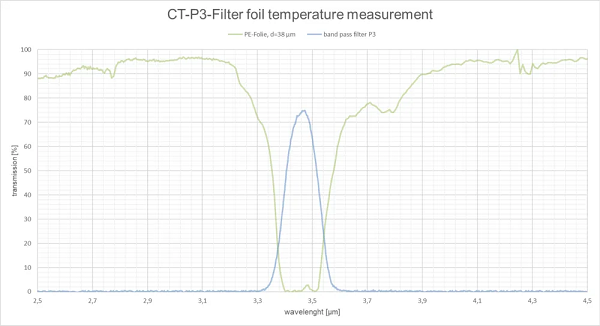
실제 응용에서는 대상 물질이 연속적인 흑체 스펙트럼보다는 파장에 따라 크게 달라지는 피크 형태의 방출을 보이는 경우가 많습니다. 방출도가 높은 등급이 선호되는 경우가 많은데, 이는 측정 장비에 대해 높은 수준의 복사를 제공하기 때문입니다. 이를 알면 관련 스펙트럼으로 파장대를 제한할 수 있습니다. 예를 들어 P3 장비는 플라스틱 재료의 온도를 특정 파장에서 측정합니다. 플라스틱 필름의 온도 측정에 표준의 넓은 밴드를 사용하는 것은 오해를 불러일으킬 수 있지만, 폴리에틸렌의 경우 3.43 µm에서 측정하는 것이 효과적입니다.
An optical filter is an optical element used to select or eliminate specific spectral characteristics of light. These filters are essential in applications that require the transmittance of an exact wavelength to an analyzer (detector), while other wavelengths are discriminated and filtered out.
Optical filters are typically based on a substrate that has significant transmittance for the desired wavelength range. When the material’s properties are responsible for light selection, the filter is known as an absorption filter. By adjusting the material’s thickness, the light is gradually filtered to achieve the desired spectral characteristics and define a reasonable waveband.
In contrast, dielectric, thin-film, or interference filters function as reflecting filters. These filters do not absorb light; instead, they select light through reflection or transmission. They consist of several thin layers of refractive dielectric material, typically applied to the substrate via vacuum deposition. Interference effects favor the transmission of specific wavelengths. These filters must confine the waveband to the desired range while avoiding atmospheric absorption, which can affect temperature measurement accuracy. Therefore, bandpass filters are widely used to define cut-on and cut-off wavelengths, effectively limiting the light spectrum on both sides.
Before the light reaches the detector, its characteristic emission spectrum is modified due to the transmittance of the optical elements and the spectral sensitivity of the detector. In temperature measurement, this process is primarily influenced by the Planck emission spectrum for blackbody radiation. Given the broad range of this spectrum, it is common to select a specific range that aligns with both the detector’s spectral response and an atmospheric window.
In practical applications, the target material often emits peaks rather than a continuous blackbody spectrum, with emission varying significantly with wavelength. A high emission grade is often preferred, as it leads to a high level of radiation for the measurement device. By knowing this, we can limit the waveband to the relevant spectrum. For example, the P3 device measures the temperature of plastic materials at a specific wavelength. While using a standard wide band for measuring temperature in plastic foils can be misleading, measuring at 3.43 µm for polyethylene is effective.