



NETD (Noise Equivalent Temperature Difference) : 등가 잡음 온도차
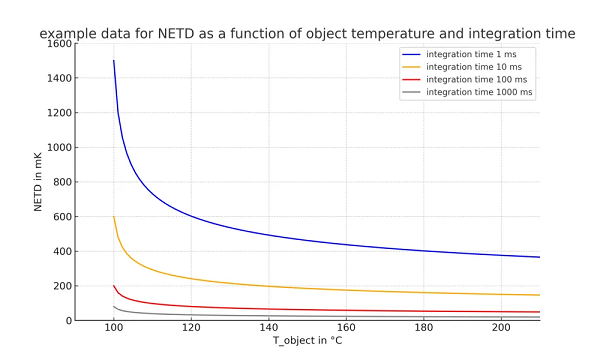
NETD는 장치의 잡음으로 인해 발생하는 적외선 온도 측정 기술의 측정 불확실성에 기여하는 요소입니다. 이는 측정 결과 재현성의 하한을 결정합니다.
값이 작을수록 측정이 더 정확해집니다. 적외선 카메라의 경우 NETD 값이 작을수록 노이즈가 적고 명암비가 높은 이미지가 생성되어 작은 온도 차이도 더 잘 보입니다. 영상용 장비의 산업적 용도에서는 대부분의 응용에 대해 100 mK의 온도 분해능이면 충분합니다.
약어 NETD는 noise equivalent temperature difference(잡음 등가 온도차)를 의미합니다. 이는 디지털화된 잡음이 있는 검출기 신호와 계산된 온도(역시 잡음이 있음) 사이의 관계가 보통 매우 비선형임을 나타냅니다. 결과적으로 NETD는 신호 강도, 즉 대상의 온도와 대상의 방사율에 크게 의존합니다. NETD는 방사율의 역수에 비례합니다. 예를 들어 방사율이 0.5이면 NETD는 두 배가 됩니다. NETD는 보통 온도 측정 범위의 초기에 가장 높고 대상 온도가 높아질수록 감소합니다.
광파온계(pyrometer)의 경우 NETD는 일정한 대상 온도에서 연속으로 빠르게 측정한 100회 온도 판독값의 단순 표준편차(신뢰수준 68.3%)입니다. 이는 측정 조건이 일정할 때 이후의 측정값들이 99.7%의 확률로 +/- 3*NETD 범위 내에서 변동한다는 것을 의미합니다. 적외선 이미저의 경우 NETD는 모든 검출 소자에 대해 동일하지 않습니다. 여기 제시된 값은 모든 검출 소자의 NETD 값들의 평균값에 근접한 값입니다. 자세한 내용은 VDI 지침 5585를 참조하십시오.
또한 NETD는 적분 시간에 따라 달라지며 주변 온도에 따라 달라질 수 있습니다. 잡음은 특정 신호 처리 방식에 크게 좌우됩니다. 신호대잡음비는 적분 시간을 길게 하면 향상될 수 있으나 장치의 응답 속도가 저하되는 대가를 수반합니다.
낮은 NETD와 높은 응답 속도를 동시에 달성하기 위해 Optris는 사용자가 소프트웨어를 통해 구성할 수 있는 “Smart Averaging” 모드를 광파온계에 제공합니다. 평균화 시간(Averaging Time)과 Smart Averaging 임계값(Smart Averaging Threshold)이라는 두 매개변수를 설정합니다. 지정된 평균화 시간 내에서 측정값의 잡음이 감소합니다. 그러나 입력되는 측정 신호는 내부적으로 여전히 최고 속도로 평가됩니다. 급격한 신호 변화로 인해 Smart Averaging 임계값을 초과하면 처리된 측정 신호는 새로운 신호 수준으로 순간적으로 이동하고 그때부터 측정값이 다시 평균화됩니다.
특별히 언급되지 않는 한 Optris 문서에 기재된 모든 값은 mK 단위로 표시되며 주변 온도가 23 °C +/- 5 °C이고 방사율 설정이 1.000일 때 유효합니다.
The NETD is a contribution to the measurement uncertainty of any infrared temperature measurement technology, the cause of which is the device noise. It determines the lower limit of the reproducibility of the measurement results.
Smaller values lead to more accurate measurements. In the case of infrared cameras, smaller NETD values also lead to a less noisy and higher-contrast image, in which even small temperature differences are more visible. In industry for imagers, a temperature resolution of 100 mK is sufficient for most applications.
The acronym NETD stands for noise equivalent temperature difference. This indicates that the relationship between the digitized noisy detector signal and the calculated temperature, which is also noisy, is usually highly non-linear. As a consequence, the NETD depends strongly on the signal strength, i.e. on the object temperature and the emissivity of the object. The NETD is proportional to the inverse of the emissivity. For example, the NETD doubles with an emissivity of 0.5. It is usually highest at the beginning of the temperature measuring range and decreases with a higher target temperature.
In the case of pyrometers, the NETD is the simple standard deviation (confidence level of 68.3%) of 100 rapidly consecutive temperature readings at a constant object temperature. This means that under constant measurement conditions, the subsequent measured values will vary within an interval of +/- 3*NETD with a probability of 99.7%. For infrared imagers, the NETD is not the same for all detector elements. The value given here is close to the mean value of the NETD values of all detector elements. For more details see VDI guideline 5585.
Further, the NETD depends on integration time and may depend on ambient temperature. The noise is highly dependent on the particular signal processing. The signal-to-noise ratio can be improved with a longer integration time but at the expense of the response time of the device.
To achieve both a low NETD and a high response speed, Optris offers the “Smart Averaging” mode for its pyrometers, which can be configured via the user software. The two parameters Averaging Time and Smart Averaging Threshold are set. The noise of the measured values is reduced within the specified averaging time. However, the incoming measurement signal is still evaluated internally at the highest speed. If the Smart Averaging Threshold is exceeded due to a rapid signal jump, the processed measurement signal jumps to the new signal level and the measured values are averaged again from then on.
If not stated otherwise all values given in Optris documentation are stated in mK and are valid when the ambient temperature is 23 °C +/- 5 °C und with an emissivity setting of 1.000.