



Modulation Transfer Function (MTF) : 변조 전달 함수
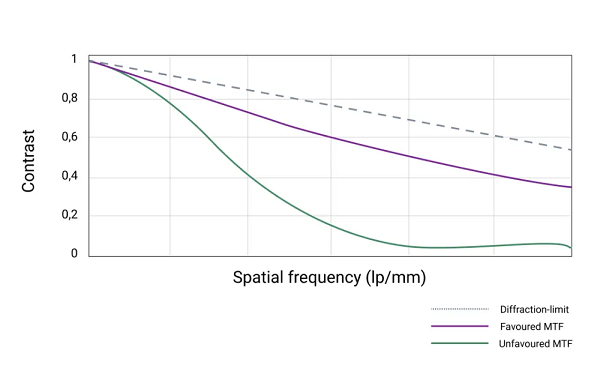
변조 전달 함수(MTF)는 시각에서 장파 적외선(LWIR)을 이용한 열화상에 이르기까지 다양한 응용 분야에서 광학 시스템의 성능을 특성화하는 중요한 지표입니다. MTF는 렌즈 시스템이 물체의 세부를 이미지로 얼마나 잘 재현(전달)할 수 있는지를 공간 주파수별 사인파 패턴의 콘트라스트 비율로 표현합니다. 얻어진 MTF 곡선은 공간 주파수의 함수로서 남아 있는 콘트라스트를 보여줍니다. 이 방법은 광학 해상도와 따라서 온도 측정 분야에서의 측정 정확도를 설명하는 수단입니다.
MTF에 영향을 미치는 요인으로는 사용되는 파장의 길이, 광학계의 F-수, 그리고 렌즈 제조의 불완전으로 발생할 수 있는 렌즈 수차 등이 있습니다. 광학 구성요소만의 MTF와 검출기의 MTF를 결합한 시스템 MTF를 구분하는 것이 중요합니다. 열화상 카메라에서는 시스템 MTF가 결정적이며 검출기 픽셀 크기의 영향을 크게 받아 전체 이미지의 광학적 해상도를 좌우합니다.
광학적으로는, 조리개에서의 회절이 에어리 디스크(Airy disk) 패턴을 생성하며, 이는 파장과 F값에 의해서만 결정되는 이론적 성능 한계를 나타냅니다. 이 거동은 회절 한계로 볼 수 있으며 최선의 경우를 의미합니다. 실제로는 광학 계가 굴절력으로 복사를 굴절시키며, 센서면에 초점을 맞출 때 수차가 발생합니다.
이 모든 요소는 목표 기준의 MTF 값을 감지기 배열에서의 MTF 출력으로 낮춥니다.
열화상 카메라의 파장 범위가 LWIR 대역으로 설정되었기 때문에 낮은 F값은 점점 더 중요해집니다. 이것은 작은 측정 시야(MFOV)와 작은 대상에 대해서도 높은 대비를 보장합니다. 그러나 F값은 합리적인 열 분해능과도 관련이 있습니다. 광학적 및 열적 분해능(NETD)을 향상시키기 위해 낮은 F값은 고급 열영상에서 가장 중요한 매개변수 중 하나입니다.
MTF는 선쌍 밀도(lp/mm)로 정량화되며, 선쌍 밀도가 높을수록 더 높은 공간 주파수에 해당합니다. 시스템이 세부 묘사를 표현하는 능력은 컷오프 주파수에 접근함에 따라 감소합니다. 이 주파수 한계는 광학계의 파장 λ와 F-Number N에 의해 결정되며 다음과 같이 표현할 수 있습니다:
f0,optics = 1 / (λ ⋅ N)
큰 센서를 사용할 경우 이미지 중심부의 대비는 보통 최적이지만, 열영상의 가장자리에서는 감소합니다. 대부분의 영상 응용에서는 이것이 허용될 수 있지만, 온도 측정에서는 MTF 감소가 완만하게 유지되는 것이 가장 중요합니다.
광학의 영향 외에도 카메라 검출기(detector) 역시 MTF 성능에 큰 영향을 미칩니다. 픽셀 크기 d는 대상의 샘플링 비율을 결정하며 컷오프 주파수, 즉 나이퀴스트 주파수를 정의합니다:
f0,det = 1 / (2 ⋅ d)
이 주파수를 초과하면 앨리어싱이 발생할 수 있으며, 이는 열영상 정보에 영향을 미칠 수 있습니다.
정확한 온도 측정을 위해, 특히 작은 분리된 대상의 경우 대상 크기가 측정 시야(MFOV)에 대응해야 합니다. 이는 단순한 검출이 아니라 정확한 온도 구분을 위해 광학적 분해능이 충분함을 보장합니다.
The Modulation Transfer Function (MTF) is a crucial metric used to characterize the performance of optical systems across various applications, from visual to long-wave infrared (LWIR) wavebands used in thermal imaging. MTF assesses how well a lens system can reproduce (transfer) detail from the object to the image, expressed as the contrast ratio of a sinusoidal pattern at different spatial frequencies. The resulting MTF curve shows the remaining contrast as a function of the spatial frequency. In this case, it is a method for describing the optical resolution and thus the measuring accuracy in the field of temperature measurement.
Factors affecting MTF include the wavelength of light used, the F-number of the optics, and lens aberrations—which may arise due to imperfections in lens manufacturing. It is important to differentiate between the MTF of the optical components alone and the system MTF, which combines the optics MTF with that of the detector. In thermal imaging cameras, system MTF is critical and heavily influenced by the detector’s pixel size, affecting overall image optical resolution.
Optically, diffraction at the aperture generates an Airy disk pattern, which represents the theoretical performance limit, solely determined by the wavelength and the F-number. This behavior can be seen as the diffraction limit and stands for the best case. In practice the optics will bend the radiation with its refracting power and aberrations will be introduced while focusing it on the sensor plane.
All together will lower the MTF value from the target reference to the MTF output on the detector array.
As the wavelength range of the thermography camera is set to LWIR waveband, a low F-number becomes increasingly important. It ensures a small measurement FOV (MFOV) and high contrast even for small targets. However, the F-number is also related to the reasonable thermal resolution. Enabling enhancing optical and thermal resolution (NETD) a low F-number is one of the most essential parameters for advanced thermal imaging.
MTF is quantified in terms of line pairs per millimeter (lp/mm), where a higher density of line pairs equates to higher spatial frequencies. The system’s ability to render details diminishes as it approaches a cutoff frequency. This frequency limit is driven by wavelength λ and F-Number N for the optics system and can be expressed by:
f0,optics=1λ⋅N
With large sensors, the contrast in the center of the image is usually optimal, while it decreases at the edges of the thermal image. For most imaging applications this may be acceptable, but for temperature measurement, it is most important that the MTF decrease remains moderate.
In addition to the influence of the optics, the camera detector also has a major effect on the MTF performance. The pixel size d determines the sampling rate of the target and defines the cut-off frequency, which is also known as the Nyquist frequency:
f0,det=12⋅d
Exceeding this frequency can lead to aliasing, which may affect the thermal image information.
For accurate temperature measurements, especially when dealing with small isolated targets the target size must correspond with the Measurement Field of View (MFOV). This ensures that the optical resolution is sufficient for accurate temperature differentiation rather than just detection.