



Emissivity : 방사율
방사율(emissivity, ε)은 물체가 열 복사를 방출하는 능력을 나타내는 지표입니다. 이는 실제 물체의 복사휘도와 이상적인 열원인 흑체(black body)의 복사휘도 간의 비율로 정의됩니다. 흑체의 방사율은 1인 반면, 모든 실제 물체의 방사율은 1보다 작습니다.
방사율 ε = ε(θ, ϕ, λ, T)는 표면에 대한 복사 각도(θ, ϕ), 파장(λ), 그리고 온도(T)의 함수입니다. 시판되는 대부분의 적외선 온도계는 흑체 복사원을 기준으로 교정됩니다. 측정 대상 물체의 방사율을 알고 이를 장비 설정에 정확히 입력하면, 측정 신호를 이상적인 열 방출원과 연관시킬 수 있으며, 이를 통해 해당 물체의 표면 온도를 계산할 수 있습니다.
비금속 표면의 경우, 수직 시야각에서 벗어날수록 방향 방사율은 서서히 감소합니다. 금속 표면에서는 각도에 따른 의존성이 더 복잡하게 나타납니다. 적용 분야나 재료에 따라 이러한 요인이 측정 불확도에 미치는 영향은 무시할 수 있기도 하고 그렇지 않기도 합니다.
특수 분광 필터를 사용하면 방사율의 각도 의존성을 제한할 수 있으며, 특히 조리개 각도가 넓은 카메라에서 모든 영상 영역에 대해 정확한 측정값을 얻는 데 도움이 됩니다.
방사율은 모든 방사 방향에 대해 단일 파장에서 고려할 수도 있는데, 이를 분광 반구 방사율(spectral hemispherical emissivity)이라 하며, 모든 파장을 대상으로 고려하는 경우에는 전반구 방사율(total hemispherical emissivity)이라고 합니다. 비금속 재료의 반구 방사율은 장파장 영역에서 비교적 높고 일정한 반면, 노출된 금속 표면의 경우에는 현저히 낮으며 파장이 길어질수록 더욱 감소합니다.
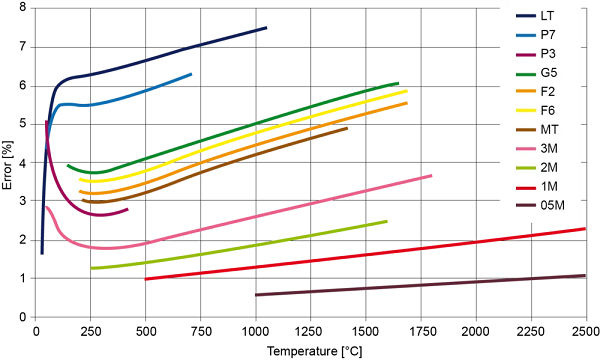
방사율은 복사 평형 계산에서 보정 계수로 사용되므로, 방사율이 낮아질수록 측정 불확도는 증가합니다. 따라서 물체의 방사율이 가능한 한 높은 파장 영역에서 감도를 갖는 측정 장비를 사용하는 것이 바람직합니다(ε(λ) = ε_max). 금속의 경우에는, 측정 온도 범위의 요구 조건을 충족하는 범위 내에서 가능한 한 짧은 파장을 사용하는 것이 이에 해당합니다.
이 효과가 측정값에 미치는 영향은 방사율을 주 운전점에 가까운 값으로 설정함으로써 줄일 수 있으며, 이 경우 물체 온도가 현저히 낮거나 높을 때에만 편차가 발생합니다. 또는 물체 온도가 방사율에 미치는 영향이 파장에 대해 비교적 독립적인 경우(ε(λ, T) ∼ ε(T)), 비율식 고온계(ratio pyrometer)를 사용하면 측정 오차를 줄이는 데 도움이 될 수 있습니다.
The emissivity (ε) measures an object’s ability to emit thermal radiation. It is the ratio of the radiance of a real object to an ideal thermal source, known as a black body. While a black body has an emissivity of 1, all real objects have an emissivity of less than 1.
Emissivity ε=ε(θ,ϕ,λ,T) is a function of the radiation angle (θ,ϕ) relative to the surface, the wavelength (λ), and the temperature (T). Most commercially available infrared thermometers are calibrated against a blackbody radiator. If the emissivity of a measurement object is known and set in the device configuration, the measurement signal can be correlated to the ideal thermal emitter, and its surface temperature can be calculated.
The directional emissivity slowly decreases for non-metallic surfaces as the deviation from the vertical viewing angle increases. For metallic surfaces, the angular dependence is more complex. Depending on the application or material, these influences on the measurement uncertainty may or may not be negligible.
Special spectral filters can be used to limit the angular dependence of emissivity, generating correct measured values for all image areas, especially for cameras with wide aperture angles.
Emissivity can also be considered for a single wavelength for all directions of radiation, known as spectral hemispherical emission, or for all wavelengths, known as total hemispherical emissivity. Hemispherical emissivity for non-metallic materials is relatively high and constant at high wavelengths, while for bare metal surfaces, it is significantly lower and drops at longer wavelengths.
As emissivity is used as a correction factor in the radiation balance calculation, the measurement uncertainty increases as emissivity decreases. It is advisable to use a measuring device with a spectral sensitivity at which the object emissivity is as high as possible (ε(λ)=εmax)
. For metals, this would be the shortest possible wavelengths that still meet the requirements for the measuring temperature range.
The influence of this effect on the measured value can be reduced by setting the emissivity to a value close to the main operating point so that deviations only occur for significantly lower or higher object temperatures. Alternatively, the use of a ratio pyrometer can help reduce the measurement error if the influence of the object temperature on the emissivity is relatively independent of the wavelength (ε(λ,T)∼(ε(T))
.