



Diffraction-Limited System : 회절 한계 시스템
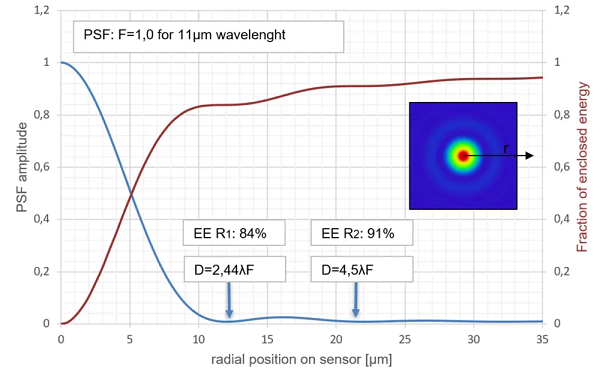
광학에서 회절 한계(diffraction-limited) 시스템이란 빛의 회절 거동에 의해 결정되는, 달성 가능한 최고 수준의 광학 해상도를 구현하는 시스템을 의미합니다. 이러한 시스템은 광학 수차를 제거하며, 이론적으로 가능한 최상의 광학 해상도의 기준이 됩니다. 회절 한계 시스템에서는 이상적인 점상(point-like) 이미지가 형성되는 대신, 에어리 디스크(Airy disk)라 불리는 회절 패턴이 생성됩니다. 이 패턴의 특성은 사용되는 빛의 파장(파장대)과 광학 시스템의 F-넘버 N에 따라 달라집니다.
열화상 분야에서는 특히 픽셀 크기가 작아지고 8 µm~14 µm의 장파장 적외선(LWIR) 대역을 사용할수록 회절 현상이 카메라 센서에 형성되는 영상 품질에 큰 영향을 미칩니다. 점 형태의 목표물을 검출기 평면에 초점 맞춘다는 것은, 복사 에너지를 픽셀 크기보다 작은 점으로 집속시키는 것을 의미합니다. 에어리 디스크의 직경은 d = 2.44 · λ · N이라는 식으로 근사할 수 있으며, 이 직경은 에어리 디스크의 첫 번째 영점(first zero point)까지를 기준으로 정의되고, 이 범위 안에는 대상에서 방출된 에너지의 약 84%가 포함됩니다.
광학 수차가 최소화된 광학 시스템은 회절 한계(diffraction-limited) 시스템이라고 불립니다. 스트렐 비(Strehl ratio)는 실제 광학 시스템에서의 광학 품질을 정량적으로 나타내는 지표로, 값이 1일 경우 수차가 없는 이상적인 광학 시스템을 의미합니다. 스트렐 비가 0.8에서 1 사이에 있으면 회절 효과가 지배적이며 광학 수차의 영향은 무시할 수 있는 수준임을 뜻합니다. 반대로 스트렐 비가 0.8 이하로 떨어지면 광학 수차의 영향이 점점 커지게 됩니다. 영상 시스템에서는 성능 품질을 분류하기 위해 변조 전달 함수(MTF)를 회절 한계와 비교하는 경우가 많습니다. 광학 설계자들은 합리적인 재료비와 제조 비용을 고려하면서 이 한계 값에 최대한 근접하도록 설계하는 것을 목표로 합니다.
열화상 분야에서는 흑체의 방출 스펙트럼을 규정하는 플랑크 법칙에 따라, 실온(T = 300 K) 물체를 측정할 때 일반적으로 8 µm~14 µm 파장대가 선호됩니다. 열화상은 주로 저온 측정을 위해 사용되는 장파장 적외선(LWIR) 대역으로 제한됩니다. 광학 성능의 향상은 주로 낮은 F-넘버를 통해 이루어지며, 이는 더 높은 광학 해상도와 수차 감소를 보장합니다. 경쟁력 있는 광학 시스템은 낮은 F-넘버(높은 광학 해상도와 유리한 NETD와 직결됨)와 회절 한계 성능을 동시에 갖추는 것이 특징입니다. 이러한 균형을 달성하는 것은 특히 소형 대상 측정이나 높은 영상 세부 표현이 요구되는 응용 분야에서 정확한 온도 측정을 위해 매우 중요합니다.
In optics, a diffraction-imited system achieves the highest optical resolution possible, determined by the behavior of light diffraction. Such a system eliminates optical aberrations and sets the standard for the best possible optical resolution. Instead of producing a sharp point-like image, it creates a diffraction pattern known as the Airy disk. The properties of this pattern depend on the wavelength of the light used (waveband) and the F-number N of the optical system.
In thermal imaging, diffraction often influences the image quality captured on the camera sensor, especially as pixel sizes decrease and the long wave infrared (LWIR) waveband of 8 µm -14 µm is used. The goal of focusing a point-shaped target onto a detector plane is to focus the radiation onto a point that is smaller than the pixel size. The diameter of the Airy disk can be estimated by the formula d=2.44∙λ∙N, where the diameter is defined by the first zero point of the Airy disk, containing 84% of the target’s encircled energy.
An optical system with minimal aberrations is referred to as a diffraction-limited system. The Strehl ratio quantifies optical quality in real systems, where a ratio of 1 indicates aberration-free optics systems. A Strehl ratio between 0.8 and 1 signifies that diffractive effects dominate and aberrations are negligible. When the Strehl ratio falls below 0.8, optical aberrations become increasingly relevant. In imaging systems, the Modulation Transfer Function (MTF) is often compared against the diffraction limit to classify performance quality. Optical designers aim to approach this limit value as closely as possible, given reasonable material and manufacturing costs.
In thermography, the typical preferred waveband is usually 8 µm -14 µm for measuring objects at room temperature (T=300 K), as dictated by Planck’s law characterizing the emission spectrum of a blackbody. Thermal imaging is limited to the LWIR waveband, commonly used to measure low temperatures. Enhancing optical performance is primarily achieved through a low F-number, ensuring higher optical resolution and reduced aberrations. A competitive optical system combines a low F-number (which correlates with high optical resolution and favorable NETD) with a diffraction-limited system. Achieving this balance is critical for accurate temperature measurements, particularly in applications involving small targets or requiring precise image detail capture.