



Detector Resolution : 검출기 해상도
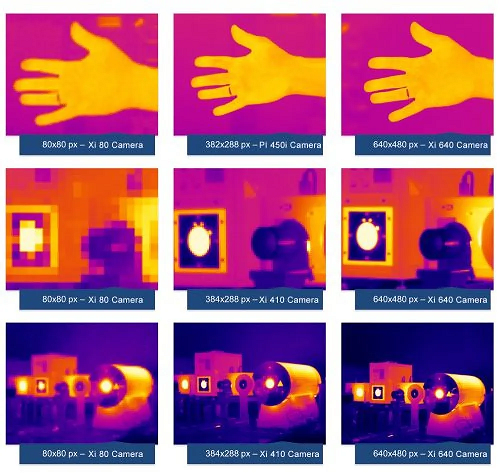
적외선 영상에서 검출기 해상도는 적외선 검출기 어레이에 포함된 개별 픽셀의 수와 이 픽셀들이 제공하는 공간 해상도를 의미합니다. 이는 적외선 카메라가 생성하는 열화상 이미지의 세부 표현력과 선명도를 결정합니다. 검출기 해상도가 높을수록 카메라는 더 많은 세부 정보를 담은 이미지를 획득할 수 있어, 보다 정밀한 열 분석과 관측 장면 내의 작은 특징 식별이 가능해집니다. 적외선 검출기의 해상도는 일반적으로 640 × 480과 같이 격자 형태로 배열된 픽셀 수로 표현되며, 여기서 640은 수평 픽셀 수를, 480은 수직 픽셀 수를 의미합니다. 검출기 어레이의 각 픽셀은 적외선 복사를 포착해 전기 신호로 변환하며, 이 신호는 이후 처리 과정을 거쳐 열화상 이미지로 생성됩니다.
더 높은 검출기 해상도는 여러 가지 장점을 제공합니다. 이는 광학적 회절 한계에 이르기까지 열화상 이미지에서 더욱 미세한 세부 사항을 감지할 수 있게 해줍니다. 픽셀 수가 많을수록 적외선 카메라는 더 많은 온도 데이터 포인트를 수집할 수 있으며, 그 결과 온도 측정의 정확도가 향상되고 온도 구배를 더 잘 식별할 수 있습니다. 높은 해상도는 보다 선명하고 또렷한 이미지를 제공하여 열적 이상 현상을 식별하고 분석하는 데 용이합니다.
반면, 검출기 해상도가 높을수록 카메라의 처리 성능에 대한 요구가 커지고 데이터 파일 크기가 증가할 수 있습니다. 또한 고해상도 검출기를 제조하기 위해서는 높은 정밀도와 복잡한 공정이 필요하므로 비용이 더 많이 들 수 있습니다. 검출기 해상도는 열화상 이미지의 세부 표현력, 정확도, 그리고 전반적인 품질에 직접적인 영향을 미칩니다.
In the context of infrared imaging, detector resolution refers to the number of individual pixels in the infrared detector array and the spatial resolution these pixels provide. It determines the level of detail and clarity in the thermal images produced by the infrared camera. Higher detector resolution means the camera can capture more detailed images, allowing for more precise thermal analysis and identification of smaller features within the observed scene. The resolution of an infrared detector is typically described by the number of pixels arranged in a grid, such as 640 x 480, where 640 represents the number of horizontal pixels and 480 represents the number of vertical pixels. Each pixel in the detector array captures infrared radiation and converts it into an electrical signal, which is then processed to create a thermal image.
Higher detector resolution provides several advantages. It enables the detection of finer details in the thermal image, up to the optical diffraction limits. With more pixels, the infrared camera can capture more temperature data points, leading to more accurate temperature readings and better identification of temperature gradients. Higher resolution can result in clearer and sharper images, making it easier to identify and analyze thermal anomalies.
However, higher detector resolution also demands more from the camera’s processing capabilities and may result in larger data files. It can also be more expensive due to the complexity and precision required in manufacturing high-resolution detectors. Detector resolution directly impacts the detail, accuracy, and quality of thermal images.