



Cavity Effect : 공동 효과
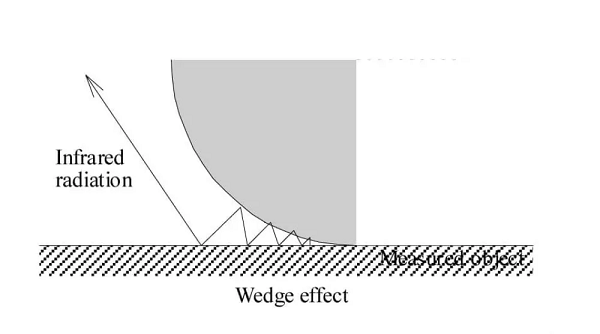
적외선 열화상에서의 공동 효과(cavity effect)는 구멍, 홈, 오목부와 같은 공동 내부에 있는 표면의 겉보기 방사율이, 동일한 표면이 평평하거나 노출되어 있을 때보다 더 높게 나타나는 현상을 의미합니다. 이러한 겉보기 방사율의 증가는 공동 내부에서 적외선 복사가 여러 차례 반사되면서 발생합니다. 공동 내부에서 방출되거나 반사된 적외선 복사는 외부로 빠져나오기 전에 공동 벽에 여러 번 부딪힐 수 있습니다. 이 과정에서 각 반사는 복사가 흡수되고 다시 방출될 가능성을 높여, 결과적으로 표면의 겉보기 방사율을 증가시킵니다.
공동에서 관찰되는 높은 겉보기 방사율은 이러한 다중 반사의 누적 효과에 기인합니다. 내부에서 반복되는 반사들이 결합되어, 재료 고유의 방사율과 무관하게 방사율 값이 약 0.998에 근접하는 거의 완전한 흑체와 유사한 환경을 형성합니다. 이러한 준(準)흑체 거동은 재료 방사율의 변화나 배경 복사가 측정값에 미치는 영향을 최소화합니다. 유효 방사율을 1에 가깝게 얻기 위해서는 구멍의 깊이가 직경의 최소 6배 이상이어야 합니다.
이 현상은 웨지 효과(wedge effect)라고도 불립니다. 웨지 또는 반(半) 웨지 효과를 활용하면 측정 대상 표면의 방사율을 향상시킬 수 있습니다. 이 방법은 재료가 본래 공동 구조를 형성하는 경우이거나, 드릴로 뚫은 구멍이나 코일과 같이 인위적으로 공동을 만든 경우에만 적용됩니다.
The cavity effect in infrared thermography describes the phenomenon where the apparent emissivity of a surface within a cavity—such as a hole, groove, or recess—appears higher than that of the same surface when it is flat or exposed. This increase in apparent emissivity arises from the multiple reflections of infrared radiation within the cavity. When infrared radiation is emitted or reflected inside a cavity, the radiation can bounce off the cavity walls several times before exiting. Each reflection within the cavity enhances the likelihood of radiation being absorbed and re-emitted, effectively increasing the surface’s apparent emissivity.
The higher apparent emissivity observed in a cavity is due to the cumulative effect of these multiple reflections. The combined internal reflections create an environment resembling a nearly perfect blackbody, with an emissivity value approaching 0.998, regardless of the material’s inherent emissivity. This near-blackbody behavior minimizes the influence of changes in material emissivity or background radiation on the measurement. The hole must be at least six times deeper than its diameter to achieve an effective emissivity close to one.
This phenomenon is also known as the wedge effect. By employing the wedge or semi-wedge effect, the emissivity of the measured surface is enhanced. This method only applies when the material naturally forms a cavity or when an artificial cavity, such as a drilled hole or coil is created.