



Thermopile : 서모파일
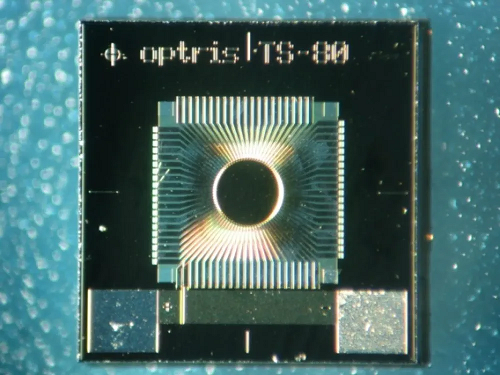
서모파일(thermopile)은 적외선 분광 범위의 전자기 복사를 전기 신호로 변환할 수 있는 열 복사 검출기입니다.
입사 집중된 복사는 흡수율이 높은 물질에서 온도 변화를 일으킵니다. 열전쌍과 마찬가지로, 세벡 효과(Seebeck effect)는 두 금속의 접점 사이에 온도 차가 있을 때 접점에서 작은 전압이 발생하도록 합니다. 이러한 열전쌍(예: 80개)이 이제 열적으로 병렬로 연결되고 전기적으로 직렬로 연결되면, 측정 신호로 사용할 수 있는 충분히 높은 열전압을 생성할 수 있습니다. 이러한 배치는 열전 쌓(thermoelectric pile) 또는 서모파일이라고 불립니다.
이들 검출기는 약 7 ms에서 150 ms의 시정수를 갖습니다. 이 기술이 비접촉 적외선 온도 측정에 사용되는 경우, 측정 대상의 온도는 접촉식 측정보다 훨씬 빠르게 결정될 수 있습니다. 서모파일(thermopile)은 검출기 자체보다 훨씬 더 차가운 장면에 대해서도 평가 가능한 신호를 생성합니다. 즉, 실온 또는 검출기 온도 이하의 온도도 측정할 수 있습니다. 측정 범위는 -40 °C부터 시작하는 것이 가능합니다. 최신 서모파일은 매우 강한 열전압을 발생시켜 그 신호를 증폭 없이 수 미터 길이의 신호선으로 직접 전송할 수 있습니다. 또한 검출기 자체가 최대 250 °C까지 견딜 수 있기 때문에 증폭 회로가 없는 설계는 양자 검출기에서는 불가능한 놀라운 주변 온도 범위를 갖는 센서의 구성을 가능하게 합니다. 온도 분해능을 극대화하기 위해 증폭을 사용하는 경우 0.1 K 미만(예: 0.025 K) 값도 달성할 수 있습니다.
Thermopiles are thermal radiation detectors that can convert electromagnetic radiation from the infrared spectral range into an electrical signal.
The incoming focused radiation leads to a temperature change in a material with high absorption. As with thermocouples, the Seebeck effect causes a small electrical voltage to arise at the contact points of two different metals when there is a temperature difference between the contact points. If any such thermocouples (e.g., 80) are now connected thermally in parallel and electrically in series, a sufficiently high thermoelectric voltage can be generated, which serves as a measurement signal. Such an arrangement is called a thermoelectric pile or thermopile.
These detectors have time constants of approximately 7 ms to 150 ms. If this technology is used for non-contact infrared temperature measurement, the temperature of a measurement object can be determined significantly faster than with contact measurement. Thermopiles also generate an evaluable signal for a scene that is significantly colder than the detector itself. This means that temperatures below room temperature or the detector’s temperature can also be measured. Measuring ranges starting at -40 °C are possible. Modern thermopiles generate such a strong thermoelectric voltage that their signal can be sent directly, i.e., without amplification, via a signal line several meters long. As the detector itself can withstand temperatures of up to 250 °C, the absence of an amplifier circuit enables the construction of a sensor with an astonishing ambient temperature range, which is not possible with quantum detectors. If amplification is used to maximize the temperature resolution, values of less than 0.1 K (e.g., 0.025 K) can be achieved.