



Spot Size Ratio : 스팟 크기 비율
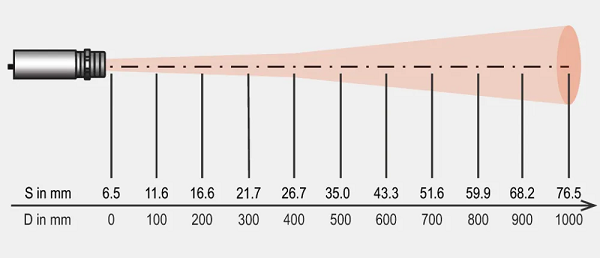
거리 대 스폿 크기 비율(distance to spot size ratio, 때로는 스폿 크기 비율(SSE)로 불림)은 온도 측정 기기(예: 온도계나 열화상 카메라)의 광학 해상도를 설명하는 데 널리 사용되는 지표입니다. 이는 대상의 측정 거리(초점 거리) D와 측정 스폿 크기와의 비율로 계산됩니다. D:S 비율 값을 사용하면 특정 거리에서 장치의 측정 스폿 크기를 계산할 수 있습니다. 대상 크기가 측정 스폿 크기 이상일 경우 매우 정확한 온도 측정이 보장됩니다. 즉, 대상이 정확히 측정 스폿 크기일 때 측정 장치는 대상 에너지의 최소 90%를 검출합니다.
초점 조절 가능한 장치에서는 전체 측정 범위에 대해 단일 D:S 비율이 적용됩니다. 비록 거리가 증가함에 따라 스폿 크기는 커지지만 비율은 일정하게 유지됩니다.
반대로 소형 파이로미터와 같은 고정 초점 장치의 경우 D:S 비율은 특정 초점 거리에서만
주어집니다. 대상을 초점에서 벗어나게 하면 D:S 비율이
감소하여 측정 스폿이 커지고 온도 편차가 발생할 수 있습니다.
광학적 관점에서 D:S 비율은 측정 장치의 초점 거리 F와 검출기 크기 d와 관련이 있습니다. 초점 거리가 길수록 D:S 비율은 향상되지만 일반적으로 측정 장치의 크기도 커집니다. 그래서 소형 장치는 종종 더 보수적인 D:S 비율을 갖습니다. 일부 응용에서는 대상 물체가 크고 전체를 검사해야 하며 대상 전체 크기에 대한 평균 온도를 측정해야 하기 때문에 이는 유용할 수 있습니다.
열화상 카메라에서는 최소 스폿 크기 개념도 일반적입니다. 검출기 어레이의
각 픽셀은 잠재적 측정 스폿을 나타내며 순간 시야(IFOV)를 정의합니다. 픽셀 크기가 종종 작고 회절 한계로 인해 날카로운 스폿 대신 에어리 디스크가 생성되기 때문에 높은 온도 정확도를
얻기 위해서는 한 개 이상의 픽셀이 필요합니다. 이 스폿 크기는 측정
FOV(MFOV)로 알려져 있으며 보통 3×3 픽셀을 포함합니다. 이 경우 MFOV는 파이로미터의 측정 스폿과 비교할 수 있으며 열화상
카메라에 대해서도 D:S 비율을 계산할 수 있습니다.
The distance to spot size ratio (sometimes referred as spot size ratio SSE) is a widely used metric to describe the optical resolution of temperature measurement instruments, such as thermometers or thermography cameras. It is calculated by the ratio between the measurement distance (focal distance) D of the target and the measurement spot size. Using D:S ratio value can be used to calculate the measurement spot of the device at a specific distance. If the target size is at least equal to the size of the measurement spot, highly accurate temperature measurement is guaranteed. That means the measurement device detects at least 90 % energy of the target if the target is exactly the size of the measurement spot.
In devices with adjustable focus, a single
D:S ratio is applied for the full measurement range. Although the spot size
increases with distance, the ratio remains constant. Conversely, fix focus
devices, such as compact pyrometers, the D:S ratio is given only for a certain
focal distance. Shifting the target out of the focus, the D:S ratio is
decreasing, leading to a larger measurement spot and potential temperature
deviations.
From the optics point of view, the D:S ratio is related to the focal length F and detector size d of the measurement device. A longer focal length results in an enhanced D:S ratio, but also in a typically larger dimension of the measurement device. That’s why compact devices have often more moderate D:S ratios. In some applications this can be useful because the target object is large and needs to be tested in its entirety, taking an average temperature measurement over the total size of the object.
For thermal imaging cameras, the concept of the minimum spot size is also common. Each pixel out of the detector array is representing a potential measurement spot, defining the instantaneous FOV (IFOV). Because the pixel size is often small and the diffraction-limit creates an Airy-disk rather than a sharp spot, more than one pixel is required to achieve high accuracy in temperature measurement. This spot size is known as measurement FOV (MFOV) and usually encompassing 3×3 pixels. In that case the MFOV is comparable to the measurement spot of a pyrometer and D:S ratio can also be calculated for thermography cameras.