



Active Thermography : 능동 열화상
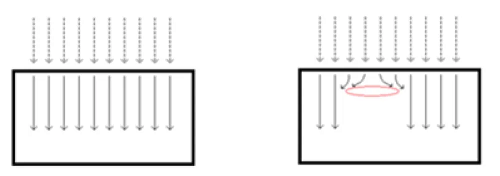
수동 열화상(Passive Thermography)은 온도 자체를 측정하는 데 중점을 두는 반면, 능동 열화상(Active Thermography)은 물체 표면 아래에 존재하는 구조적 결함을 검출하는 데 목적이 있습니다. 이러한 비파괴 검사 기법은 락인 열화상(Lock-in Thermography)이라고도 불리며, 육안이나 일반 카메라로는 확인할 수 없는 균열, 섬유 마모, 개재물, 박리(delamination) 등 다양한 재료 결함을 효과적으로 식별할 수 있습니다.
기본 원리는 결함이 없는 대상 물체에 단시간의 고에너지 전자기 복사를 인가하는 것입니다. 이상적으로 연속성과 균질성이 유지된 물체에서는 열에너지가 내부에서 등방성(isotropic)으로 전달되어, 모든 방향으로 균일하게 확산됩니다. 또한 균일한 표면을 가진 물체의 경우, 열 자극 이후 표면의 모든 지점은 동일한 속도로 냉각되는 것이 정상입니다.
그러나 표면 아래에 육안으로 확인되지 않는 균열이나 결함이 존재할 경우, 물체 내부의 균일한 에너지 흐름이 방해되거나 표면으로 반사됩니다. 이로 인해 결함 주변 영역은 열 자극 후 냉각되는 데 더 많은 시간이 소요됩니다. 반대로, 일부 경우에는 이물질의 존재로 인해 에너지 전달이 증가하여 해당 영역이 더 빠르게 냉각되기도 합니다.
실제 적용에서는 일반적으로 펄스형 광 플래시를 이용해 에너지를 대상 물체에 인가합니다. 이 외에도 마이크로파, 초음파, 와전류와 같은 다양한 에너지원이 사용될 수 있습니다. 인가되는 에너지는 표면 온도를 충분히 상승시킬 수 있을 만큼 커야 하며, 이후 발생하는 미세한 온도 분포의 불균일성을 고감도 열화상 장비를 통해 감지합니다.
에너지원의 강도, 펄스 간격, 펄스 폭, 그리고 자극과 측정 간의 위상 차이 등의 파라미터를 조절함으로써, 표면 아래에 존재하는 다양한 구조적 결함을 효과적으로 가시화할 수 있습니다.
Passive thermography differs from active thermography in that the focus is not on measuring temperature. Instead, active thermography is used to detect structural defects beneath the surface of an object. This non-destructive technique, also known as “lock-in thermography,” is highly effective for identifying material defects such as cracks, fraying, inclusions, delamination, or other irregularities that are not visible to the naked eye or standard cameras.
The basic principle involves introducing a short burst of high-energy electromagnetic radiation into an undamaged object. In an ideal, uninterrupted object, the resulting thermal energy flow within the object is isotropic, meaning it is uniform in all directions. It’s also expected that any point on a uniform surface will cool down at the same rate after being thermally stimulated.
However, if there is an invisible crack beneath the surface, the uniform energy flow inside the object is disrupted or reflected to the surface. As a result, the area surrounding the defect takes longer to cool down after being stimulated. In some cases, the presence of foreign material can enhance energy flow, leading to faster cooling.
In practice, energy is introduced into the object using a pulsed flash of light. Other energy sources such as microwaves, ultrasound, or eddy currents can also be used. The energy must be sufficiently high to raise the surface temperature. Any deviations from a uniform temperature are detected using a sensitive thermal imaging device. Adjusting parameters such as intensity, pulse intervals, pulse width of the energy source, and the phase between stimulation and measurement provides a wide range of possibilities for revealing hidden subsurface features.