



Single Wavelength Measurement : 단일 파장 측정
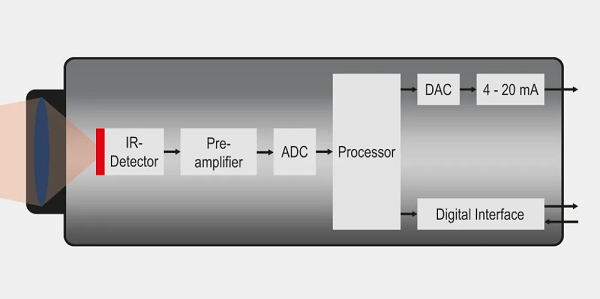
플랑크의 복사 법칙에 따르면 모든 물체는 전자기 복사를 방출합니다. 이 복사를 올바르게 검출하고 평가하면 물체의 표면 온도를 계산할 수 있습니다. 단일 파장 측정의 경우, 검출기가 물체가 방출하는 모든 열 복사를 평가하는 것은 아니며 상대적으로 좁은 스펙트럼 범위 내의 복사만을 평가합니다. 나머지 복사는 분광 필터를 사용하여 구별됩니다. 대부분의 상업용 적외선 온도계(파이로미터 및 적외선 카메라)는 이 개념을 사용합니다.
이 절차는 신호 세기와 장치의 감도를 감소시키지만, 여러 가지 이유로 실무에서는 필요합니다. 첫째, 검출기의 스펙트럴 응답은 전체 전자기 스펙트럼에 대해 최적화될 수 없습니다. 사용 가능한 적외선 검출 재료(예: 0.4 µm~1.1 µm 범위의 실리콘, 1.3 µm~2.6 µm 범위의 InGaAs 등)는 이미 적외선 온도계의 사용을 위해 특정 스펙트럴 범위를 지정합니다.
둘째, 다양한 대기 가스가 적외선 복사의 투과도에 영향을 미칩니다. 이러한 가스들이 측정 결과(물체 온도)에 미치는 영향을 최소화하려면, 대기 창(atmospheric windows)이라 불리는 이러한 가스의 영향이 적은 적외선 스펙트럼 영역을 사용하는 것이 바람직합니다.
셋째, 측정 대상의 방사율은 특정 스펙트럼 범위에서는 매우 작고 공정 중에 급격히 변할 수 있는 반면, 다른 스펙트럼 범위에서는 비교적 크고 일정할 수 있습니다. 이러한 경우에는 의미 있는 측정을 위해 더 불안정한 신호 범위를 배제하는 것이 더 유리합니다.
대안으로 이중 파장(dual-wavelength) 측정이 있는데, 이 방법은 서로 다른 스펙트럼 범위에 민감한 두 검출기의 신호를 평가합니다.
According to Planck’s radiation law, every body emits electromagnetic radiation. If this radiation is detected and evaluated correctly, the surface temperature of the body can be calculated. With single wavelength measurement, not all the thermal radiation emitted by a body is evaluated by a detector, but only radiation within a relatively small spectral range. The remaining radiation is discriminated by the use of spectral filters. Most commercial infrared thermometers (pyrometers and infrared cameras) use this concept.
Although this procedure reduces the signal strength and thus the sensitivity of the device, it is necessary in practice for various reasons. Firstly, the spectral response of detectors cannot be optimized for the entire electromagnetic spectrum. The available infrared detector materials (e.g., silicon for the range 0.4 µm to 1.1 µm, InGaAs for the range 1.3 µm to 2.6 µm, etc.) already specify certain spectral ranges for the use of infrared thermometers.
Secondly, various atmospheric gases influence the transmissivity of infrared radiation. To minimize the influence of these gases on the measurement result (an object temperature), it is preferable to use the areas of the infrared spectrum that are little influenced by these gases—the atmospheric windows.
Thirdly, the emissivity of the measurement object can be very small in certain spectral ranges and subject to strong changes during the process, while it is rather large and constant in another spectral range. In such a case, it is more advantageous to discriminate the more unstable signal range for a meaningful measurement.
An alternative is dual-wavelength measurement, where the signals of two detectors are evaluated, both sensitive to different spectral ranges.