



Response Time : 응답 시간
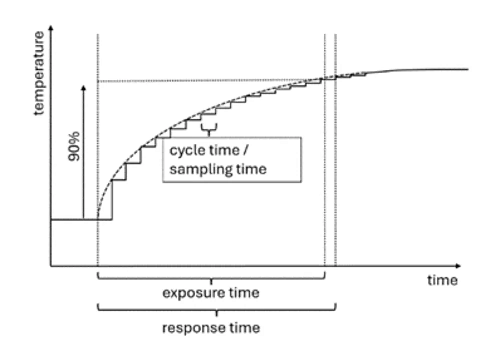
측정 대상의 온도가 갑작스럽게 상승하거나 하강한 순간과 적외선 온도계의 신호 출력(아날로그 또는 디지털)에서 최종 값의 신호 세기 중 90%에 도달하는 순간 사이의 시간 간격을 응답 시간이라고 합니다. 100% 값은 최종 온도와 초기 온도 사이의 차이에 해당합니다.
응답 시간은 사용된 검출기 기술에 크게 좌우되며, 특히 그 시간 상수와 측정
장치의 입력 펄스 전자 신호 처리가 동기화되어 있는지 여부에 따라 달라집니다. 신호 획득이 동기화되어
있지 않은 경우, 이 값은 한 사이클 시간(사이코미터의 경우) 또는 한 이미지 기간(적외선 카메라의 경우)만큼 변동할 수 있으며, 이는 빠른 사건을 기록할 때 중요할 수 있습니다. 장치 사양에는 더 큰 값을 명시해야 합니다. 응답 시간은 전체 처리
체인을 고려하지 않는 노출 시간과 구별되어야 합니다.
The time interval between an abrupt increase or decrease in the temperature of a measurement target and the moment when the infrared thermometer reaches 90% of the signal strength of its final value at a signal output (analog or digital) is known as the response time. The 100% value corresponds to the difference between the final and initial temperatures.
The response time is strongly dependent on the detector technology used, particularly its time constant and whether the input pulse electronic signal processing of the measuring device is synchronized or not. With unsynchronized signal acquisition, this value can fluctuate by one cycle time (with pyrometers) or one image period (with infrared cameras), which can be relevant when recording fast events. The larger value must be specified in the device specifications. The response time must be distinguished from the exposure time, as the latter does not take the entire processing chain into account.