



Reflectivity : 반사율
흡수율 및 투과율과 더불어 반사율은 전자기 복사와 물질의 상호작용을 특징짓는 세 가지 기본 물질 특성 중 하나입니다. 반사율은 표면에서 반사된 뒤와 반사되기 전의 복사 강도 비율로, r = I/I_0로 표시됩니다. 비율 변수이므로 단위가 없으며 0과 1 사이의 값을 가질 수 있습니다. 여기서 0은 전혀 반사가 일어나지 않음을 의미하고, 1은 완벽한 거울처럼 모든 복사가 반사됨을 의미합니다. 반사율 ????은 투과율 ???? 및 흡수율 ????와 다음 방정식으로 연결됩니다: 1=α+r+t
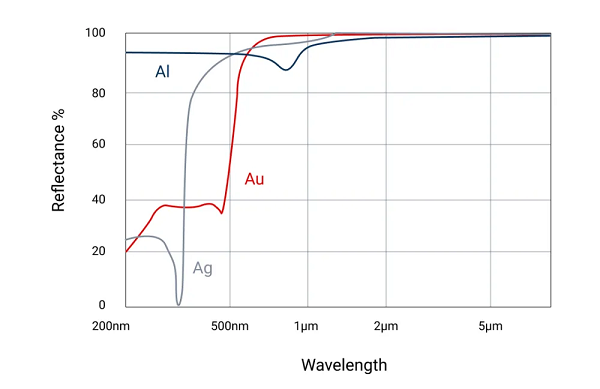
흑체의 경우 반사율은 정의상 0이지만, 실제 측정 대상체에서는 그렇지 않습니다. 흡수나 투과율과 마찬가지로 반사율은 고려하는 파장에 따라 달라집니다. 특히 금속은 매우 강한 파장 의존성을 보이며, 긴 파장에서는 90% 이상의 반사율을 가질 수 있습니다. 코팅되지 않은 유리나 플라스틱은 종종 20% 미만의 값을 갖습니다. 적절한 코팅을 사용하면 광학 소자의 반사율을 제한된 스펙트럼 범위에서 최소화하여 투과율을 최대화할 수 있습니다. 또한 흡수를 최대화하여 원치 않는 반사를 줄이는 흑화 코팅도 존재합니다.
반사율(reflectivity)과 반사도(reflectance)는 흔히 혼용되지만 광학 분야에서는 서로 구별되는 개념을 가리킵니다. 반사율은 빛의 조건이나 환경과 무관하게 물질 자체의 특성만을 고려하여 표면에 입사한 전력에 대한 반사된 전력의 비율로 정의됩니다. 반면 반사도는 반사된 세기와 입사 세기의 비율이며 표면에 영향을 미치는 외부 요인에 따라 달라질 수 있습니다.
Alongside absorption and transmissivity, reflectivity is one of the three basic material properties of objects that characterize the interaction of electromagnetic radiation with matter. Reflectivity is the ratio of the radiation intensities after and before reflection on a surface, denoted as r = I/I_0. As a ratio variable, it is unitless and can take on values between 0 and 1, where 0 means no reflection occurs at all, and 1 means all the radiation is reflected, as with a perfect mirror. Reflectivity ???? is connected to transmissivity ???? and absorption ???? according to the equation: 1=α+r+t
For a black body, the reflectivity is zero by definition, but this is not the case for any real measurement object. Like absorption or transmissivity, reflectivity depends on the wavelength under consideration. Metals, in particular, show a very strong wavelength dependence and can have reflectivity values of over 90% for longer wavelengths. Uncoated glasses or plastics often have values below 20%. With appropriate coatings, the reflectivity of optics can be minimized in a limited spectral range to maximize transmissivity. There are also blackening coatings that reduce undesirable reflectivity by maximizing absorption.
Reflectivity and reflectance are often used interchangeably, but they refer to distinct concepts in the field of optics. Reflectivity is defined as the ratio of the reflected power to the incident power on the surface of a material, considering only the properties of the material itself without regard to the conditions of the light or the environment. Reflectance, on the other hand, is the ratio of the reflected intensity to the incident intensity and can vary depending on the external factors affecting the surface.